Hollow cylindrical semi-finished titanium forgings — ring-rolled and pierced rings — supplied as starting stock for flanges, bearing housings, gear blanks and structural rings.
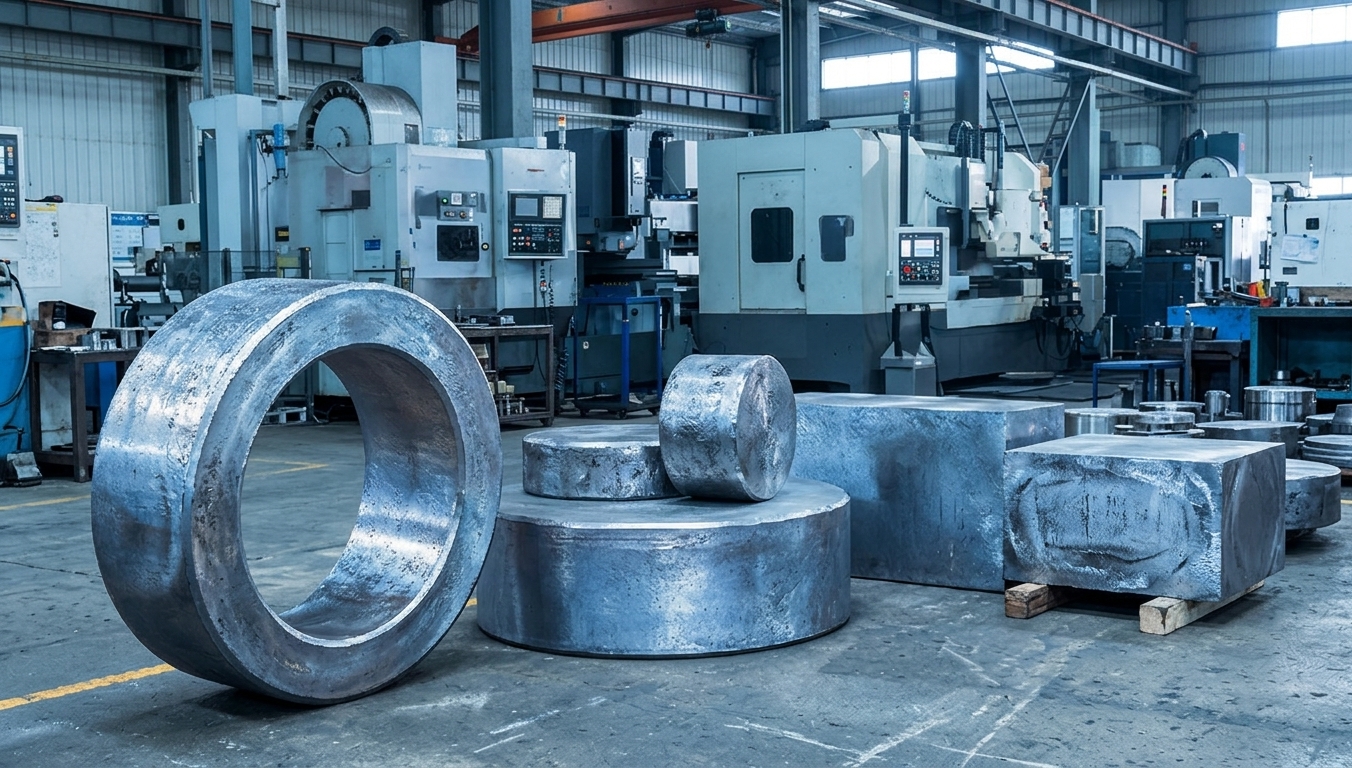
Hollow cylindrical semi-finished titanium forgings — ring-rolled and pierced rings — supplied as starting stock for flanges, bearing housings, gear blanks and structural rings.
Titanium forged rings are hollow cylindrical titanium forgings used as starting stock for ring-shaped components. The primary forming route is ring rolling — a continuous rolling process that enlarges a pierced titanium billet into a ring with a refined circumferential grain structure, reduced machining waste and improved structural properties compared to machining from a solid disc or plate cutout. Rings outside the rolling process range can be produced by open-die forging and piercing.
Feinuotai supplies forged titanium rings through three supply routes — available stock items, made-to-order forging production, and custom forging coordination for non-standard geometries. Each route has different lead time, minimum order and supply conditions. Please specify your ring dimensions, grade and quantity when submitting an inquiry.
The forging route determines the grain structure and the suitable diameter-to-wall-thickness ratio. Selecting the correct route for your application ensures the ring has the right mechanical properties and production feasibility.
Produced by continuous rolling of a pierced billet — the grain direction is primarily circumferential, aligned with the ring hoop stress. Ring rolling is the preferred route for larger diameter rings where wall thickness-to-diameter ratio is moderate. This route offers better material yield and more uniform mechanical properties around the ring circumference.
Produced by piercing a solid billet to create the inner hole, followed by open-die forging to enlarge the ring. The grain direction is less uniform than rolled rings, making this route suitable for smaller diameter rings, rings with extreme wall thickness, or geometries outside rolling machine range.
Ring-rolled rings generally offer better structural performance for rotating or pressure-containing applications. Pierced rings are available for smaller sizes, custom geometries and one-off production.
Feinuotai supplies forged titanium rings through three distinct routes. Not every ring is available from stock — the appropriate supply route depends on your required diameter, wall thickness, grade, quantity and delivery schedule.
Selected standard forged rings in common sizes — primarily Grade 1, Grade 2 CP titanium rings in frequently requested outer diameter and wall thickness combinations. Stock items can be released quickly, typically 1–3 days for domestic shipment. Current stock dimensions and grades are subject to confirmation at the time of inquiry.
Custom forged rings produced through standard forging production routes (ring rolling or open-die piercing) against customer drawings. Typical production completion time is approximately 5–10 days. Grade availability is reviewed against the ring geometry, forging route and quantity.
Non-standard ring geometries, extreme dimensions, unusual grade combinations or rings requiring additional operations (such as post-forging machining, heat treatment or special inspection). Feinuotai manages the full supply process — drawing review, production partner coordination, material sourcing, follow-up and delivery.
Not every grade, diameter or wall thickness is held in stock. Stock availability is reviewed per inquiry. Custom and coordinated forging routes require drawing and specification review before quotation.
Specify outer diameter, inner diameter, wall thickness, height and machining allowance per drawing.
Titanium forged rings are specified by five primary dimensions — outer diameter (OD), inner diameter (ID), wall thickness, height, and machining allowance. Ring-rolled and pierced rings have different production range limits, so your forging route should be confirmed early in the inquiry process. The machining allowance left on the forged blank depends on ring size, forging process and your required final tolerances.
Dimension Note: Industry reference ranges for forged ring production capability exist but vary by forging equipment. Specific feasible OD/ID/height combinations are reviewed against your drawing requirements. When submitting an inquiry, please provide your required finished dimensions so we can recommend the appropriate forging route and confirm feasibility.
Grade feasibility and supply route are reviewed per inquiry — not every grade is held in stock.
Grade availability for forged rings depends on the required ring geometry, forging route (ring-rolled vs pierced), quantity and applicable specification. Commercially pure grades (Grade 1, Grade 2) are the most commonly supplied grades for rings and are available through all three supply routes. Alloy grades such as Grade 5 (Ti-6Al-4V) require closer review of forging temperature windows and equipment capabilities before feasibility can be confirmed.
Not every grade referenced in ASTM B381 is part of our current ring supply range. Please specify your required grade when submitting an inquiry so that we can evaluate availability across the three supply routes.
Titanium forged rings supplied by Feinuotai reference ASTM B381 / B381M as the primary product standard. ASTM B381 specifies technical requirements for titanium and titanium alloy forgings, including ring forgings produced by both ring rolling and open-die piercing routes.
Additional or alternative specifications may be agreed per order where project requirements demand particular forging routes, heat treatment conditions, inspection criteria or documentation beyond ASTM B381. Please specify any additional standard or specification requirements when submitting an inquiry.
Ring geometry, machining allowances, forging route suitability and material requirements reviewed before supply route selection and quotation.
Turning, boring, milling and drilling arranged through partner workshops — quoted separately from the forging supply.
Annealing or solution treatment coordinated per order — subject to grade and required forging condition.
Material test reports, forging production records and inspection documentation coordinated per order.
Forged titanium rings are used as starting blanks for components where a ring shape is more material-efficient than machining from a solid disc or plate. Common end uses include flanges, bearing housings, gear blanks, valve bodies and bonnets, structural rings for marine and chemical process equipment, and rotating rings for specialized machinery.
In chemical processing, forged titanium rings provide corrosion-resistant starting stock for flanged connections in pipe systems handling corrosive media. In marine applications, ring-forged components benefit from titanium's saltwater corrosion resistance. Ring-rolled forgings with circumferential grain direction are preferred for applications involving hoop stress or cyclic loading.
Ring-rolled rings are produced by continuous rolling of a pierced billet, creating a more uniform circumferential grain structure. Pierced rings are produced by open-die forging of a billet with a pierced hole — suitable for smaller diameters or extreme wall thicknesses where rolling equipment cannot reach.
Selected standard forged rings in common sizes and grades (primarily Grade 1 and Grade 2 CP titanium) are available from stock. Current stock dimensions and grades are subject to confirmation at inquiry — not every size or grade is held in inventory.
Machining allowance depends on ring size, forging process and your required final tolerances. Typically extra stock is left on outer diameter, inner diameter, faces and walls. The exact allowance is agreed per drawing during quotation.
Send your ring drawing showing OD, ID, wall thickness, height and machining allowance — we will confirm stock availability or custom production feasibility, recommend the appropriate forging route, and provide pricing.
Helpful details: Ring Drawing, Forging Route Preference (Ring-Rolled / Pierced), Grade, Quantity, Delivery Schedule
Send InquiryThe parent category covering all four semi-finished forging forms.
BrowseSolid disc forgings — complementary forging form for flanged components and valve assemblies.
BrowseNon-standard forged shapes beyond ring, disc and block — coordinated per unique geometry.
Browse
Finished flange and fitting components — downstream products using forged ring starting stock.
Browse