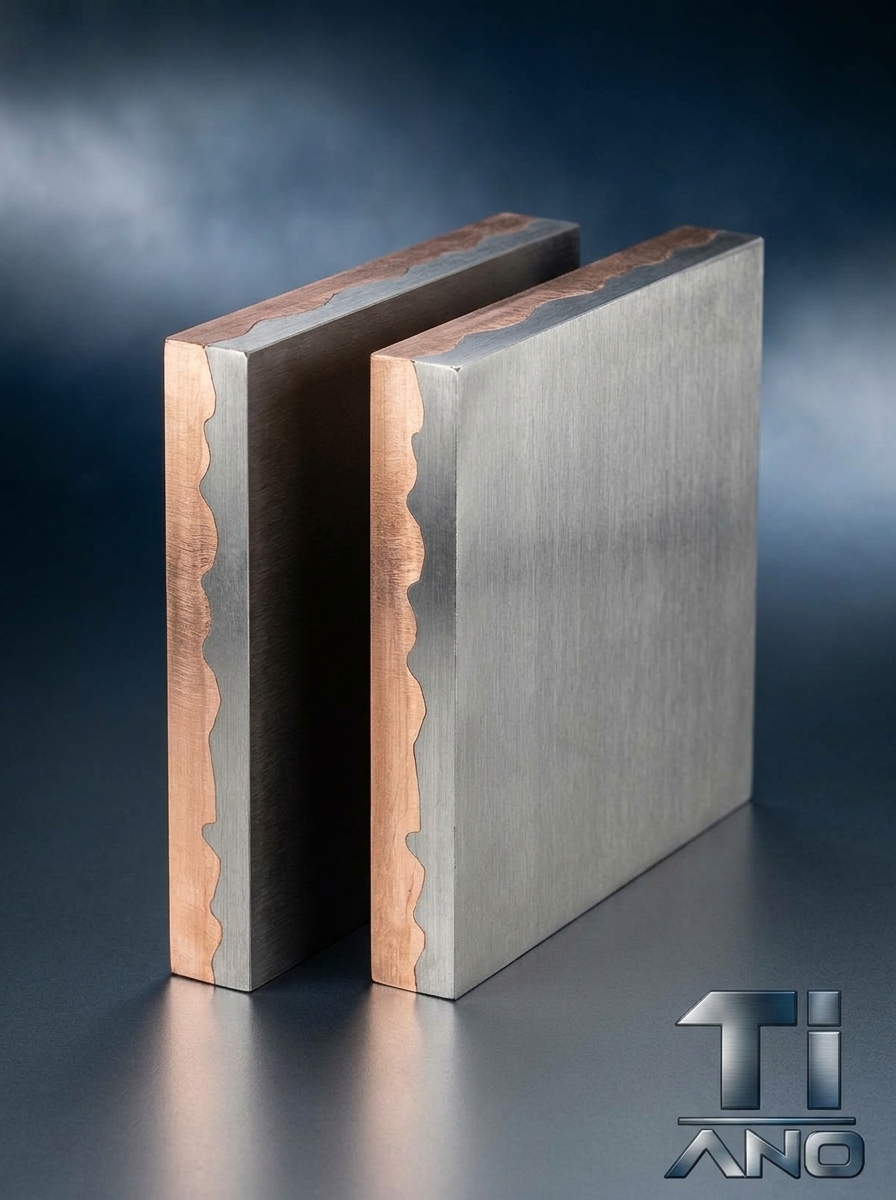
Titanium-copper composite plates manufactured by explosive bonding — combining titanium corrosion resistance with copper thermal and electrical properties. Ti cladding grade and thickness, Cu substrate grade and thickness, plate size and quantity confirmed per order.
Product Overview — Titanium-copper composite plates are flat plates where a layer of titanium cladding is metallurgically bonded to a copper substrate by explosive bonding (explosion cladding). A controlled explosive charge accelerates the titanium sheet into the copper substrate at high velocity, creating a solid-state metallurgical bond — the two metals fuse together without melting, producing a permanent, high-strength interface.
The combination brings together two properties that no single metal can offer: the corrosion resistance of titanium on the cladding surface, and the thermal and electrical conductivity of copper in the substrate. This is especially useful in applications where a titanium component needs to make electrical or thermal contact with copper infrastructure.
Ti-Cu Composite Plates vs Titanium-Clad Copper Products — not the same thing: Ti-Cu composite plates are flat explosive-bonded plate stock for applications that start as a plate or transition piece. Titanium-clad copper products are copper-core rod or busbar products with titanium cladding — different product geometry, different bonding arrangement, different downstream application. Feinuotai supplies both — use the Ti-clad-copper-products page for bar / busbar / rod inquiries.
Long-form note for procurement: Explosive-bonded Ti-Cu composite plates are specified where the assembly begins as a flat plate and needs to combine titanium's corrosion resistance with copper's electrical or thermal properties. Common starting points are transition pieces between titanium equipment and copper busbars or heat sinks, and composite mounting plates where a titanium corrosion barrier is needed on one side with copper heat dissipation on the other.
Grade 1 or Grade 2 commercially pure titanium cladding. Other CP or alloy grades evaluated per inquiry — Grade 1 and 2 are the standard explosive-cladding grades.
Copper or copper alloy substrate. Grade to be confirmed per inquiry — dependent on required conductivity and application.
Explosive bonding (explosion cladding). Diffusion bonding is not used for this product.
Coordinated with explosive bonding partner mills. Not a standard stock product.
Inquiry checklist:
Flat transition pieces between titanium equipment and copper busbars or electrical infrastructure.
Composite plates combining titanium corrosion resistance with copper heat dissipation.
Flat starting stock for machined transition components between titanium and copper systems.
Documentation supplied per order normally includes:
Please note your documentation and inspection requirements together with the Ti grade / thickness, Cu grade / thickness and plate size.
By explosive bonding (explosion cladding) — a controlled explosive charge accelerates the titanium sheet into the copper substrate at high velocity, creating a solid-state metallurgical bond without melting either metal.
Use Ti-Cu composite plates if your starting point is a FLAT PLATE that needs both titanium corrosion resistance and copper thermal / electrical properties — for example a flat transition piece, a composite mounting plate or a flat clad section. Use titanium-clad copper products if your starting point is a copper-core rod, bar or busbar that needs a titanium cladding layer — for example a titanium-clad copper busbar. See Titanium-Clad Copper Products for that form.
Yes — the explosive bond is metallurgically solid and tolerates conventional machining (cutting, milling, drilling, tapping) after bonding, subject to the specific plate thickness and bond integrity. Machining requirements should be noted in the inquiry so we can confirm the minimum plate thickness after any machining stock allowance.
Tell us Ti cladding grade and thickness, Cu substrate grade and thickness, plate size and quantity — we will confirm the explosive bonding route and provide a tailored quotation.
Helpful details: Ti Grade, Ti Cladding Thickness, Cu Grade, Cu Substrate Thickness, Plate Size, Quantity
Send Inquiry
The titanium cladding material — compare with composite plate if only titanium is needed.
BrowseComplementary product — copper-core bar or busbar with titanium cladding, produced by different bonding process.
Browse
Explosive-bonded Ti-Cu plates can be further machined to drawing — routed through custom fabrication coordination.
Browse