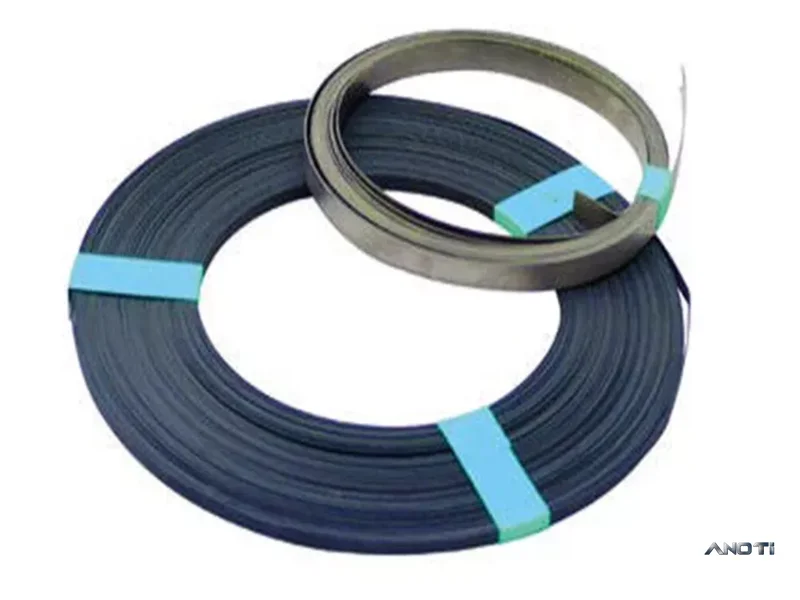
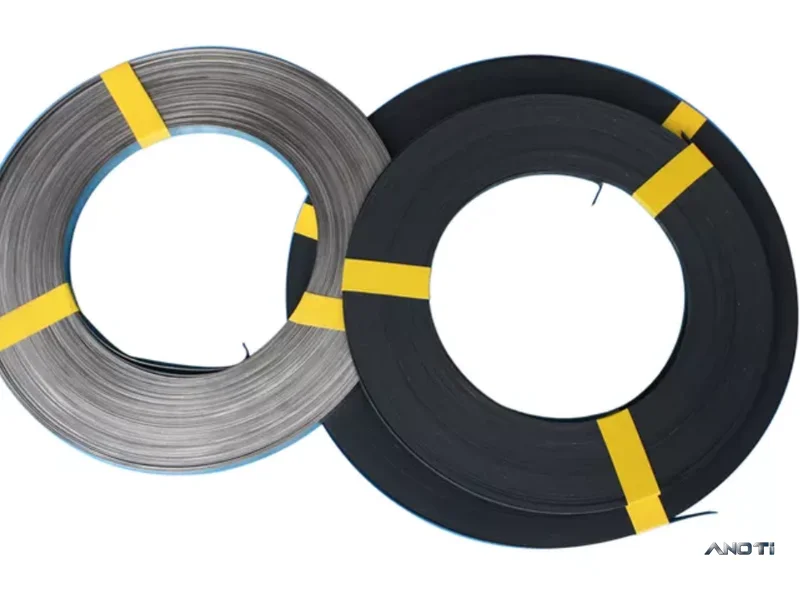
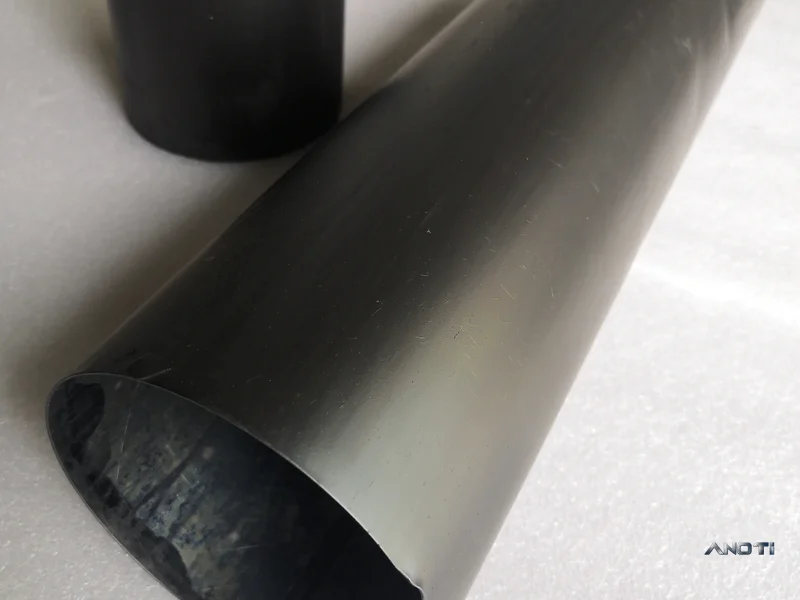
Thermal decomposition RuO₂-based mixed metal oxide coating on Grade 1 titanium substrates. Optimized for chlorine evolution in chlor-alkali, electrochlorination and low-Cl⁻ systems.
Ru-based MMO coatings catalyze the chlorine evolution reaction (CER) — the defining reaction of chlor-alkali production and electrochlorination systems.
Both Ru-based and Ir-based MMO coatings are manufactured by ANO in-house via thermal decomposition. The distinction:
Chlorine evolution: Lower overpotential for Cl₂ than Ir-based (key advantage). Optimized for high-Cl⁻ electrolytes (NaCl brine, seawater).
Oxygen evolution: Better for OER across pH range. Does not catalyze Cl₂ in low-Cl⁻ systems.
Critical limitation: Ru-based MMO degrades above ~60°C and in low-Cl⁻ or neutral electrolytes where oxygen evolution becomes favored (OH⁻ competes with Cl⁻).
ANO applies Ru-based MMO coatings using the thermal decomposition process — standard for MMO coatings. Key difference from Ir-based: higher coating loading (8–12 g/m² vs 4–8 g/m² for Ir-based).
8–12 g/m² thermal decomposition (higher than Ir-based, Ru needs more per surface area)
Up to 5 kA/m² chlorine evolution (chlor-alkali membrane cells, reference value)
Up to 60°C continuous service (Ru-based degrades above ~60°C)
Requires >0.1 M Cl⁻ (500 ppm) to maintain stable chlorine evolution
>10,000 h at 1 A/cm² in 1 M HClO₄ (industry reference value)
Grade 1 CP titanium (ASTM B265 / B338) — ANO manufactures in-house
All values: reference values, not ANO proprietary test data. Specific performance depends on Cl⁻ concentration, temperature and current density.
| Application | Ru-Based Suitability | Key Condition |
|---|---|---|
| Chlor-alkali (membrane cells) | ✅ Primary application | Saturated NaCl ~300 g/L; 60°C; 1–3 kA/m² |
| Electrochlorination (seawater) | ✅ Suitable | Seawater ~19 g/L Cl⁻; <30°C; <500 A/m² |
| Pool/spa electrochlorination | ✅ Suitable | 2–5 g/L Cl⁻; room temp |
| Hypochlorite generation electrolyzers | ✅ Anode component only | Electrolyzer system (housing/diaphragm/external coordination) |
| Oxygen evolution (low-Cl⁻) | ❌ Not recommended | Ir-based MMO is correct choice for OER |
| Above 60°C continuous | ❌ Temperature limit | Ir-based MMO stable to 80°C |