Ir-Ta MMO coated expanded mesh anodes for impressed current cathodic protection of bridge decks, parking structures, seawalls and marine concrete — 20–75 year design life.
Chloride ion penetration from de-icing salts (bridge decks) or saltwater (coastal/marine structures) causes localized corrosion of embedded steel reinforcement. Traditional patch repairs are temporary — the problem recurs as chloride continues to penetrate from untreated concrete areas. ICCP provides permanent protection.
How it works: Ir-Ta MMO expanded mesh anodes are installed within the concrete cover (shotcrete overlay or slot-and-patch method). Current flows from the mesh through the concrete electrolyte to the steel rebar, polarizing it to protective potential. The mesh remains embedded for the structure's lifetime.
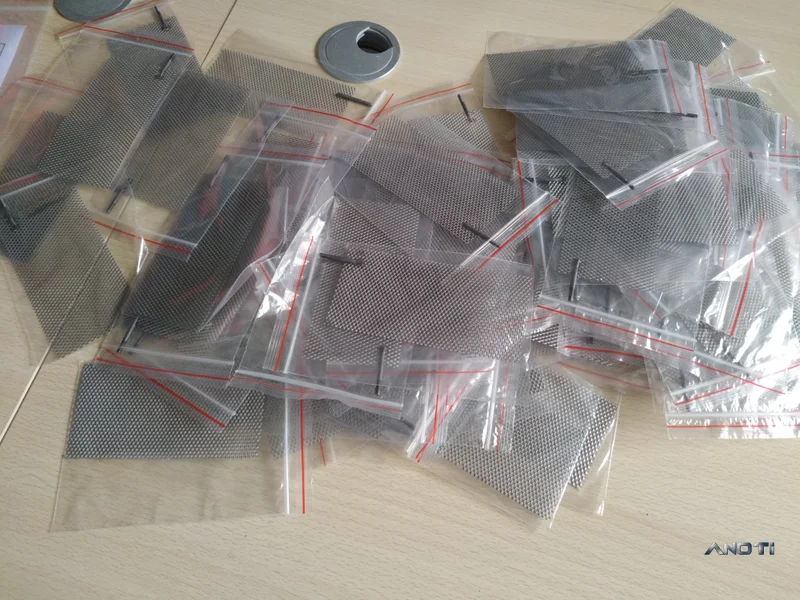
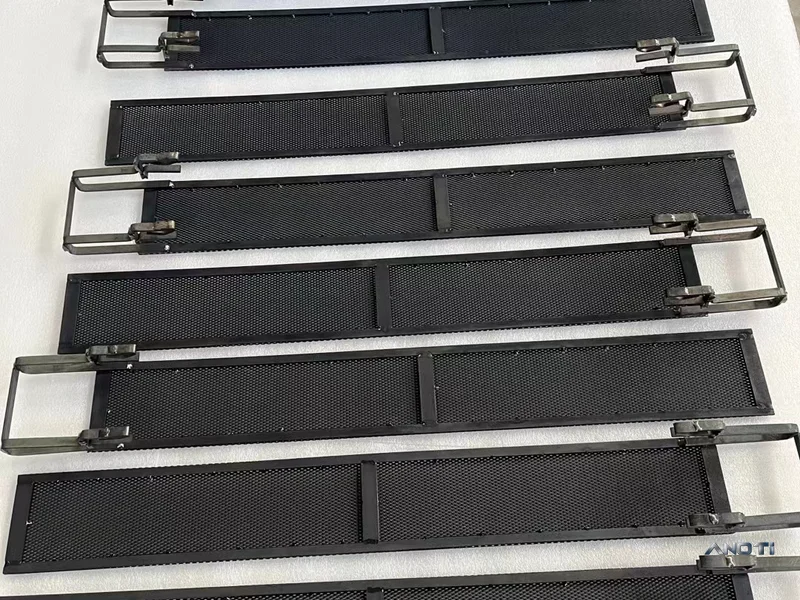
ANO Supply Model: Complete Ir-Ta MMO expanded mesh anode — Grade 1 CP titanium substrate + in-house thermal decomposition Ir-Ta MMO coating + 5 standard specification sizes covering bridge decks, parking structures, flood walls, and marine docks. All ANO in-house.
ANO offers five standard Ir-Ta MMO expanded mesh specifications, optimized for different structure types and installation methods:
Application: Small to medium area reinforced concrete bridge decks, highway overpasses, municipal parking garages.
FHWA reference current density: 110 mA/m² concrete surface area.
Form: Expanded mesh rolls (standard roll dimensions, reference values). Installed via shotcrete overlay or slot-and-patch method.
Application: Large-area coastal flood defense walls, marina bulkheads, port terminal marine concrete structures.
Key requirement: Larger mesh panel sizes for efficient installation on expansive vertical surfaces.
Form: Expanded mesh panels (standard panel dimensions, reference values). Higher total anode surface area for lower current density per unit coating.
Ir-Ta mixed metal oxide by thermal decomposition — ANO proprietary formulation
Grade 1 CP titanium expanded mesh (ASTM B265)
5 standard specification groups — roll form (bridge/parking) and panel form (flood wall/dock)
100–200 mA/m² concrete surface (reference values, FHWA standard reference)
Reinforced concrete with chloride penetration — de-icing salt zones, coastal structures, marine splash zones
20–75 year design life depending on spec group and environment (reference values)
Reference values, non-ANO proprietary test data. Mesh dimensions, coating loading per spec group and current density calculations depend on project-specific concrete resistivity, chloride level, and structural geometry.
Bridge decks with chloride contamination from de-icing salts. US FHWA and EU EN standards reference technology.
Multi-story and underground parking garages exposed to road salt tracking and moisture.
Large-area reinforced concrete seawalls and flood defense structures in marine environments.
Port docks, marina bulkheads, seawater intake structures — coastal splash and tidal zone corrosion.
110 mA/m² concrete surface area is the FHWA reference value for bridge deck ICCP. Actual current depends on measured concrete resistivity and chloride content.
Mesh geometry enables uniform current distribution across large surface areas, provides mechanical anchorage in shotcrete overlay, and has optimal surface area-to-weight ratio.
Two common methods: (1) shotcrete overlay — mesh placed over existing concrete, shotcrete sprayed over; (2) slot-and-patch — slots cut into concrete, mesh inserted, patched. Method depends on structure condition and access.
Yes — Ir-Ta MMO coating and Grade 1 titanium expanded mesh substrate are both fully in-house.
Please provide: structure type (bridge / parking / flood wall / dock), concrete surface area, estimated chloride level or test data, and intended installation method. We will recommend the optimal spec group and mesh quantity.
Send Inquiry